
Imagine paying nearly R7 more for a litre of diesel in just two weeks’ time. For farmers hauling produce, taxi drivers filling up every day, and commuters already stretched thin, that’s not just an inconvenience - it’s a growing hit to consumers' wallets.
With only a fortnight left before April’s official fuel price announcement, South Africa is bracing for one of its steepest increases in years. The Central Energy Fund’s latest data paints a grim picture: if prices were adjusted today, diesel would climb by up to R6.75 a litre, and 95-octane petrol by nearly R4. Add the 21c per litre increase in fuel levies, and we’re looking at a potential R7 surge for diesel and almost R4.20 more for petrol.
The culprits are both local and global. Brent crude oil has stormed past $100 per barrel for the first time since 2022, driven by escalating tensions in the Middle East. Meanwhile, the rand has weakened around 5% since late February, compounding the pain. Interestingly, the weaker currency’s contribution (about 30c to 44c per litre) is small compared to the oil price impact. Nevertheless, together they form a potent inflationary cocktail.
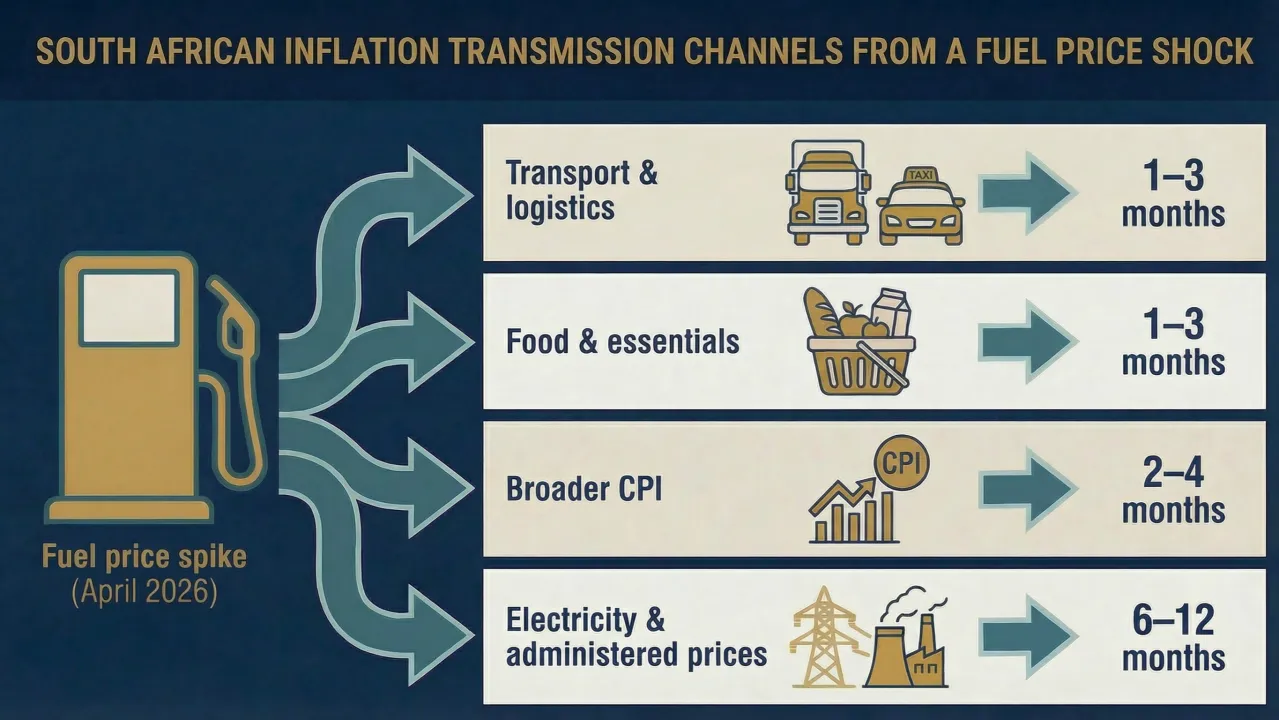
The impact of higher fuel prices on South Africa’s inflation doesn’t happen overnight. It unfolds in waves, each with its own rhythm and reach.
The transmission channels and their lags
Fuel price adjustments: 1 month lag (most direct)
South Africa’s fuel price is reset monthly by the Department of Mineral Resources and Energy, using a rolling average of global crude prices and the rand/dollar rate over the past month. A spike in early March, for example, flows straight into April’s fuel price. This makes it the fastest channel, with only a 4–6 week lag from global shifts to the pump.
Transport and food: 1 to 3 month lag
Once fuel costs rise, transport operators (think truckers, taxi fleets, and bus companies) quickly pass it through. Since nearly all goods move by road, food prices (bread, produce, chicken, etc.) are likely to feel it within 1–3 months. The SARB and Stats SA consistently identify this as one of inflation’s strongest transmission channels.
Broader CPI: 2 to 4 month lag
The full inflation impact emerges after 2–4 months, once businesses stop absorbing costs and start repricing. Manufacturing inputs, retail margins, and services adjust gradually, with SARB research showing the peak hit around month 3–4 after a fuel shock.
Electricity and administered prices: longer, delayed effect
Eskom’s costs rise when diesel-powered generation ramps up during load-shedding. While tariffs are reviewed annually, sustained fuel spikes can widen losses and raise pressure for future hikes. This unfolds over 6–12 months, making it a slower but significant inflation driver.
The rand amplifier: the wild card
Oil price surges rarely hit alone. They often strengthen the US dollar, weakening the rand, which means South Africa pays more both for oil and for the currency it’s priced in - a double blow. With Brent currently oscillating around the $100 mark and the rand already softer, this round of pass-through could be sharper and faster than usual.
Rough timeline for the current shock
Given the Hormuz closure triggered around March 2nd, you'd roughly expect:
• April 2026: Significant fuel price increase at the pumps (already being priced in)
• May–June 2026: Transport costs, food prices, and logistics costs are visibly higher in CPI prints
• June–July 2026: Peak CPI impact likely visible in headline inflation
• Beyond that: Depends entirely on how long the closure persists and whether the rand stabilises
A prolonged surge in oil prices couldn’t come at a worse time for policymakers hoping to steer inflation closer to the South African Reserve Bank’s 3% target. With the next Monetary Policy Committee meeting set for 26 March, the latest geopolitical turmoil has added fresh uncertainty to the outlook.
Governor Lesetja Kganyago has signalled that the SARB may need to rethink its risk scenarios as it faces a classic supply-side dilemma: energy costs are driving inflation higher while economic growth is losing steam. Lowering rates now could hurt the Bank’s inflation-fighting credibility, yet keeping policy tight for longer risks further squeezing households and businesses. It’s a difficult balancing act.
Despite recent pressure, the rand remains stronger than at the end of 2025 and firmer than last year’s average of R17.84 to the dollar, indicating the latest weakness is more of a correction than a collapse. That’s important, because South Africa’s fuel price formula uses monthly averages of global oil and exchange rates- not daily spikes. The bigger risk lies in how long elevated oil prices persist: a brief shock fades, but a sustained one could entrench higher inflation expectations and force the SARB to act more decisively.
For investors more broadly, the message is that “set-and-forget” portfolios are vulnerable when shocks are both inflationary and growth-negative. Equity valuations can come under pressure as earnings are squeezed by higher input costs, while bond markets may struggle if inflation expectations rise and the SARB is forced to stay restrictive for longer.
Diversification across strategies, geographies, and real assets becomes more important, as does a focus on risk management rather than simply chasing yield. In short, portfolios need to be built for a wider range of macro outcomes.
This backdrop strengthens the case for actively managed strategies such as hedge funds, which can use shorting, derivatives, and flexible asset allocation to hedge downside and seek returns from market dislocations rather than just rising markets.
First published on LinkedIn, 17 March 2026.