
Few topics are dominating dinner tables, boardrooms and newsrooms quite like the cost of living right now.
The rand, food prices, fuel, interest rates - all of it is under the microscope, and almost everyone has an opinion. Across financial markets, opinion is split. Some believe the worst is behind us and the Reserve Bank can comfortably stand still, while others worry that today’s price pressures may prove far less “temporary” than they first appeared.
The honest answer is that there is genuine uncertainty, and the debate is only becoming more construed as the new 3% inflation target is tested for the first time.
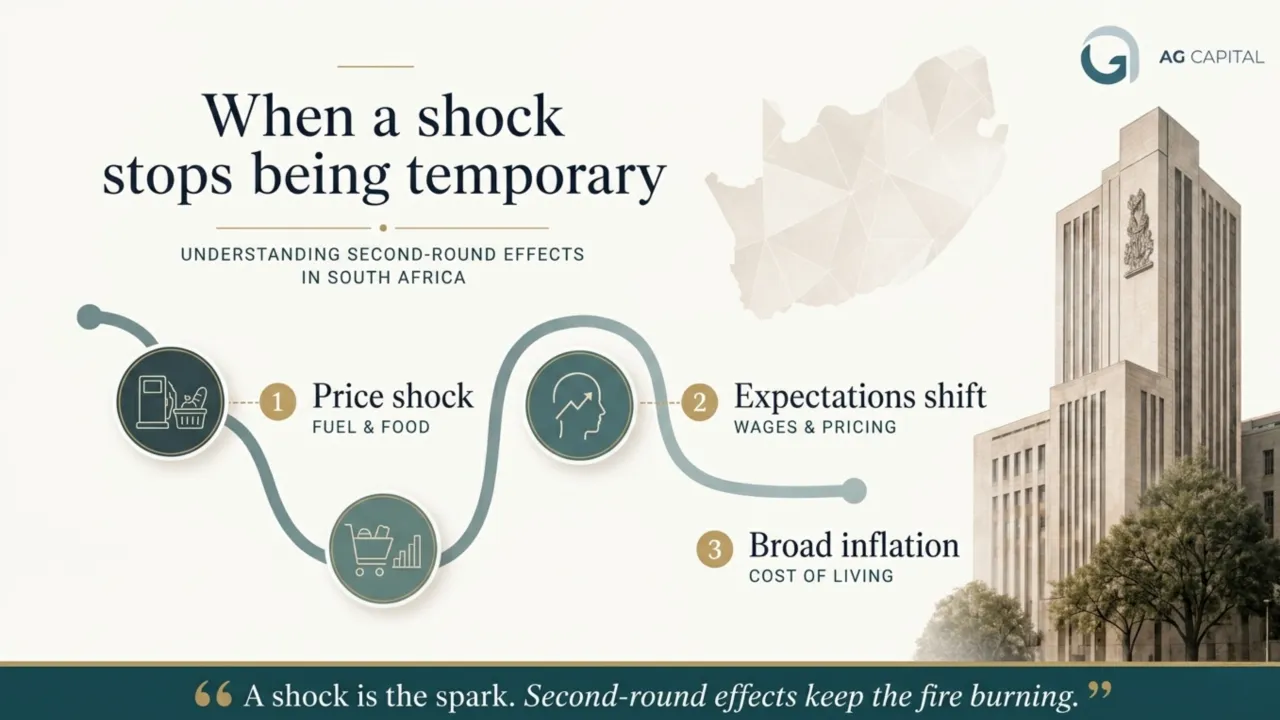
As such, it’s worth looking, in practical terms, at how we would actually tell whether a “once‑off” price shock in South Africa is slowly permeating into something more enduring. Economists often refer to “second‑round effects”. That’s just what happens when a shock in one area (like fuel or food) slowly spreads into most other prices in the economy. At that point, it’s no longer a simple fuel issue anymore; it’s regarded as a broader inflation problem. To pick that up early, you don’t just look at the latest inflation number; you look at how people plan to set prices and wages.
One of the best tools for this is the BER Inflation Expectations Survey, especially the 2‑year view. That’s the time frame the Reserve Bank watches to see if people believe inflation will really settle around the new 3% target. In the first quarter of 2026, the survey showed analysts expecting about 3.2% inflation for 2028, businesses around 3.9%, and unions about 3.7%, while households saw inflation at 5.4% over the next year. If that 2‑year number rises again in the next survey, it’s a clear warning that the shock is starting to change behaviour, not just prices.
Two other areas matter considerably: core and services inflation, and wage deals. When core inflation (which strips out volatile food and fuel prices) and services prices pick up, it usually means the pressure is spreading into “stickier” parts of the economy. Furthermore, if big wage agreements (particularly in the public sector and mining) start landing at 6% or more, it suggests both employers and unions are acting as if 4–5% inflation is the new normal, not 3%.
It is also imperative to check how widespread the price increases are. If a growing share of the inflation basket is rising faster than about 4.5%, and more companies are telling surveys they plan to push selling prices higher even while their own input costs stay contained, that’s a strong hint the shock is feeding through.
If a couple of these signals move together (say, the 2‑year expectations go up and core inflation drifts above roughly 3.5%), then it becomes very hard to argue that the central bank should keep “looking through” the shock.
That’s where the question of credibility comes in. A “temporary” supply shock becomes a real risk to South Africa’s young 3% inflation target when it lasts long enough, becomes large enough, and starts to change people’s expectations.
The 3% target is still new, and history shows that new inflation targets are usually tested in their first few years. What really matters is not the launch announcement, but how the central bank behaves the first time things get bumpy.
That’s why even a small rate hike now can be cheaper than finding out in late 2026 that 3% was more wishful thinking than reality. However, the central question I am personally struggling with: do people still believe the target, or are they subconsciously adjusting to a higher-inflation world?
First published on LinkedIn, 12 May 2026.