
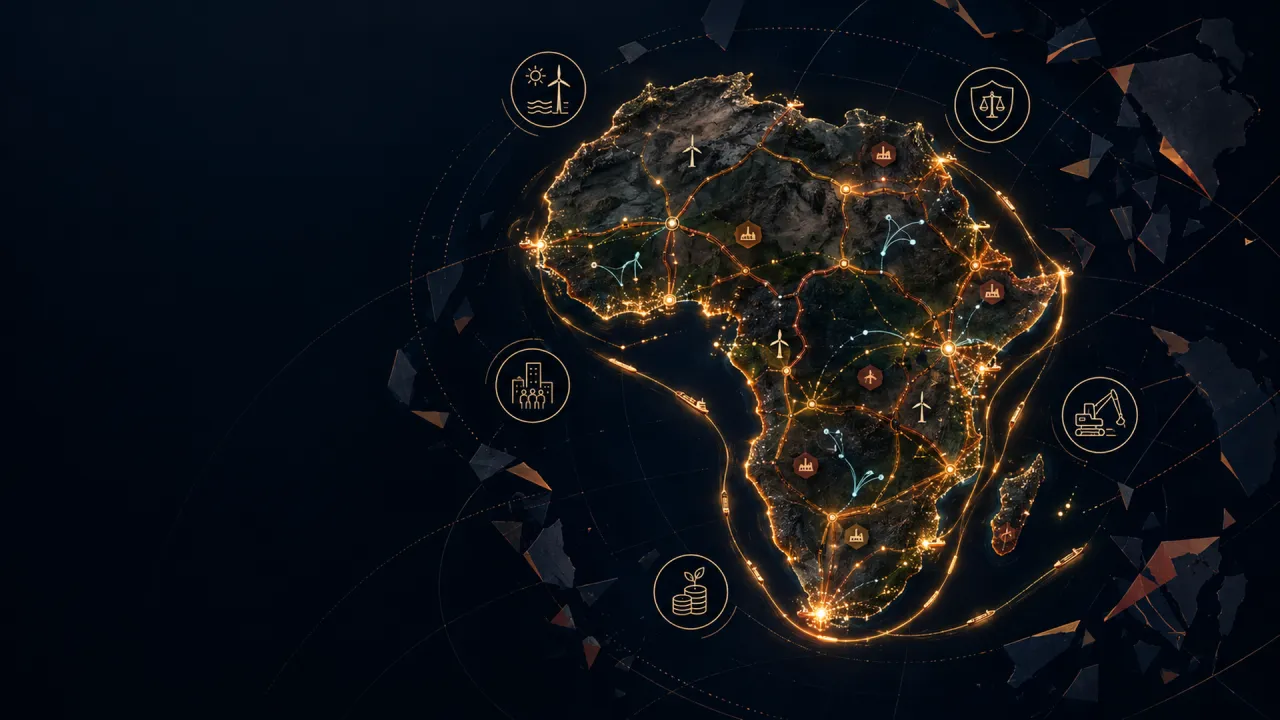
Somewhere on the edge of the African continent, a logistics warehouse is being fitted with a solar array, battery storage and its own water infrastructure. Sustainability is part of the equation, but there is also a more immediate commercial consideration: the tenant wants certainty before signing the lease.
In many ways, that building captures the African property market in 2026. Growth is not necessarily the scarce commodity; increasingly, certainty is.
I recently had the pleasure of opening up the 2026 API Summit at the CTICC in Cape Town, where over 500 delegates from around Africa attended, and I got to present about exactly this. For years, African property investment has been approached through a familiar set of questions. Which country is next? Where are populations growing fastest? Which cities offer the strongest economic growth and, by extension, the greatest property opportunity? These remain relevant, but they tell us relatively little about whether attractive economic fundamentals can ultimately be translated into durable investment returns.
Understanding where growth will occur is only the first step; the next is determining how it can be captured through investment.
The emphasis is thus on execution. Demographic growth creates demand; however, converting that demand into sustainable income depends on the environment around the asset. Reliable infrastructure, energy and supply chains underpin operations; occupiers need the financial capacity to support leases; and investors need clear routes to deploy, scale and ultimately realise capital. Property therefore provides a tangible measure of an economy’s ability to support investment - the physical balance sheet of economic capability.
A logistics warehouse tells us something about the strength of trade links and supply chains. A data centre relies on reliable power and fibre connectivity. An A-grade office building reflects corporate demand, energy resilience and changing tenant preferences. Real estate is where an economy’s capability is ultimately tested in practice- through occupancy, collection rates and income per square metre rather than forecasts alone.
This becomes especially relevant in a more fractured global environment. Geopolitical tensions, conflict, trade-policy uncertainty and volatile energy markets feed through to inflation, interest rates, construction costs, freight routes, currency stability and the availability of capital. Each of these forces ultimately feeds directly the economics of property, influencing everything from development costs and operating expenses to financing conditions and asset values.
Africa sits squarely within this changing global landscape. The continent is central to the supply of critical minerals required for the energy transition, while its growing consumer and labour markets, strategic ports and shipping routes, renewable-energy resources and rapidly developing digital economy continue to create opportunities for investment. At the same time, greater exposure to global forces means capital is becoming more selective. In an uncertain world, capital becomes more discriminating, flowing towards markets and assets that offer greater confidence in execution and long-term returns.
This suggests that Africa’s next property cycle may be defined less by the availability of land and more by the scarcity of investable ecosystems.
Land is abundant across many African markets and demand is visible. What is far scarcer is the combination of reliable infrastructure, regulatory certainty, creditworthy occupier demand, transparent development processes and patient, long-term capital. Where these elements come together, property can compound value over time. Where they do not, even a compelling demographic story may struggle to translate into investment returns.
Access to capital is therefore a critical part of the equation. South Africa currently has 33 listed real-estate investment trusts with a combined market value of approximately R333.56 billion, or around US$20.9 billion. Kenya has three listed REITs and Nigeria four, while Uganda and Mozambique have none. These numbers highlight the channels through which savings can be converted into productive built assets.
Where institutional investors participate actively, regulation is credible and reporting transparent, property markets can access deeper pools of domestic and international capital. Where those systems remain underdeveloped, attractive projects can struggle to move beyond potential. Developing pension-fund participation, improving project preparation and creating credible valuation and exit mechanisms therefore form part of the property story itself.
Ultimately, the markets that succeed will be those that can lower the cost of uncertainty and, in doing so, capture what might be described as an investability premium.
There is an important distinction between an attractive market and an investable one. A country or city may benefit from a young population, mineral resources, strategic geography or a growing consumer base. However, these characteristics become considerably more valuable when accompanied by confidence in infrastructure, institutions, information and execution. Lower uncertainty can attract deeper pools of capital, reduce funding costs and encourage developers and occupiers to make longer-term commitments. A lower risk premium lifts asset values, and it widens what can be built in the first place.
Cape Town offers a useful example. The V&A Waterfront’s long-term masterplan, estimated at between R30 billion and R40 billion over roughly 15 years, reflects the scale and patience required to build integrated urban ecosystems. Similarly, the renewable-electricity wheeling arrangement involving Growthpoint Properties and Etana Energy illustrates how property owners are increasingly becoming active participants in the infrastructure surrounding their assets.
This is likely to become a defining feature of the sector. Successful property owners will increasingly manage resilience across energy, water, mobility, security, technology and tenant experience. Successful investors, in turn, are buying the productive capacity of a place as much as the building on it.
The African real-estate opportunity therefore cannot be understood through growth alone. The more important questions are whether that growth can be financed, how it can be structured and whether the surrounding ecosystem can turn economic potential into durable returns.
Africa’s next property chapter will be written by the cities, corridors, precincts and projects capable of connecting demand to infrastructure, infrastructure to capital, and capital to long-term economic value. Growth creates the opportunity. Certainty makes it investable.
First published on LinkedIn, 23 September 2026.