

AfD’s recent sweeping result in Saxony-Anhalt has unsettled Germany’s political establishment, even if it does not put the party on the brink of national power. Instead, it brings Germany’s double reckoning into focus: a political backlash against weak growth, high living costs and a strained policy status quo, alongside a market-led reassessment of the country’s fiscal and monetary outlook. As higher oil prices revive inflation concerns and Bund yields climb through the post-QE adjustment, Berlin faces growing pressure to deliver a more forceful fiscal and pro-growth response.
AfD won about 44% of the vote and 39 of 83 seats- three short of an outright majority. With other parties still refusing to cooperate, it cannot govern alone. The result is a landmark, but Saxony-Anhalt is a small, poorer eastern state where anti-establishment sentiment runs stronger than in Germany as a whole; the political fallout from the 2024 Magdeburg attack also amplified local concerns around immigration, security and law and order.
Nationally, AfD polls around 28%, ahead of the CDU/CSU at roughly 20–21%, while the centre-left remains divided. Even so, its route to federal power is constrained by coalition arithmetic and the mainstream parties’ continuing refusal to work with it. With the next federal election only due in 2029, the government has time (and every incentive) to tackle the grievances driving support for populist parties: weak growth, elevated household costs, high taxes, bureaucracy, migration and public security.
The more likely outcome is a mainstream policy reset: stronger border and domestic-security measures, fiscal support for households and firms, tax relief, deregulation and a renewed push to improve industrial competitiveness. Germany’s comparatively modest debt and deficit levels provide room to act. Planned federal net borrowing rises from €98.0 billion in 2026 to €118.7 billion in 2027, €148.8 billion in 2028 and €152.0 billion in the 2029 election year.
A more supportive fiscal stance makes both political and economic sense, helping to cushion the energy shock and trade uncertainty while addressing the economic frustration that has boosted AfD support. It could also bring reforms investors have long wanted (lower taxes, faster permitting, reduced regulation and a more practical industrial and energy policy) without challenging Germany’s commitments to the EU, NATO and the euro area.
Politics is part of the German equation, but for markets the more immediate focus is the rise in Bund yields.
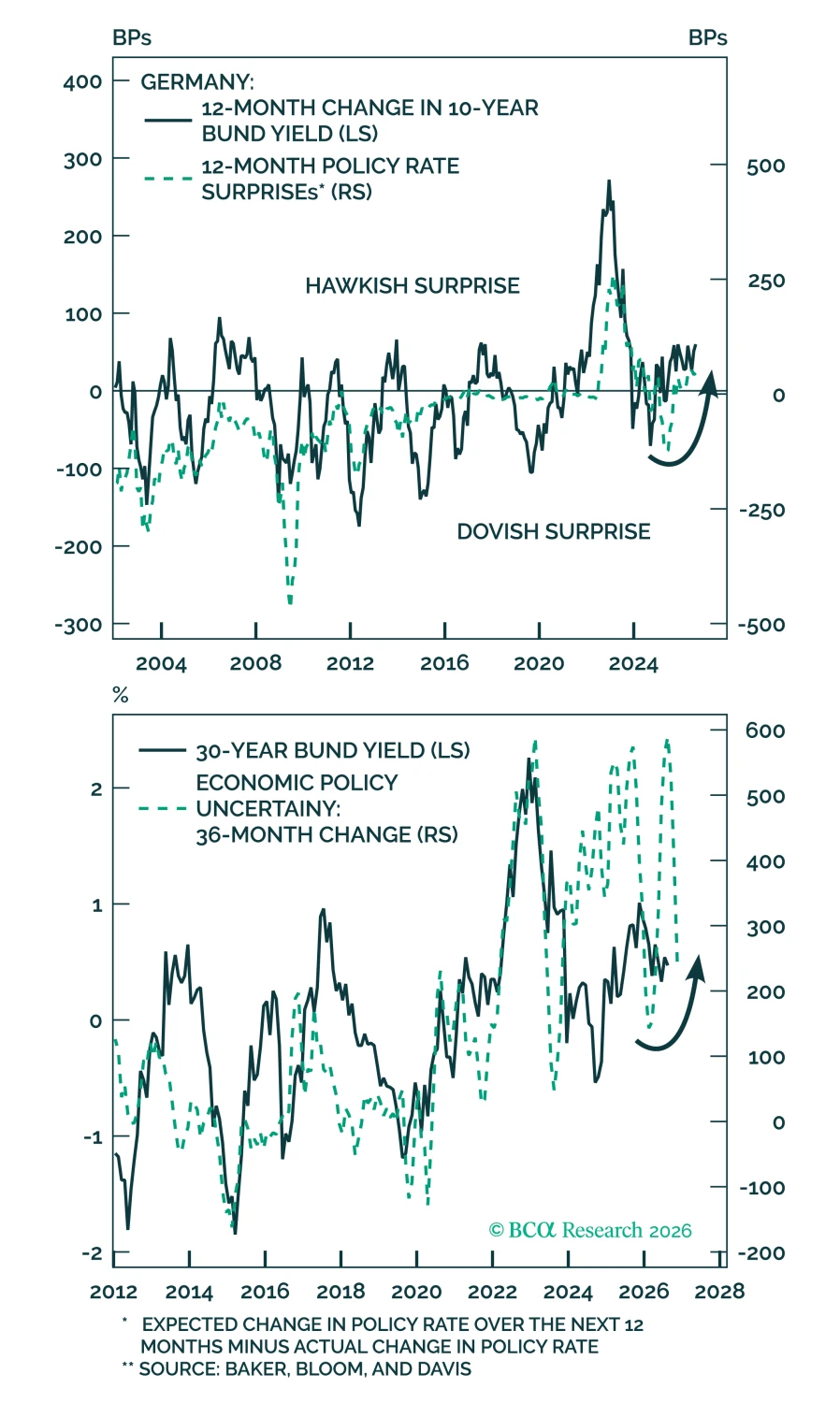
German 10-year borrowing costs have climbed to their highest level since 2009, reflecting a global bond sell-off and the market’s reassessment of a country that is simultaneously facing more fiscal issuance, higher energy costs and the residual effects of a decade of European Central Bank asset purchases. The ECB’s challenge now extends beyond the timing of its next rate move. After years of using asset purchases to hold down term premia, it must manage a gradual balance-sheet normalisation while oil-driven inflation keeps pressure on the policy outlook.
Source: BCA Research
Changes in Bund yields have historically moved with surprises in expected ECB policy, while longer-dated yields also respond to wider economic-policy uncertainty. Today, both forces are present: markets must price a potentially more hawkish ECB response to oil-driven inflation and a larger supply of German government debt as fiscal policy loosens.
That creates a difficult trade-off for Frankfurt. Higher oil prices feed directly into euro-area headline inflation, but tighter policy also raises fragmentation risk by pressuring peripheral sovereign spreads, particularly Italy versus Germany. A widening BTP–Bund spread would be an important warning sign, indicating that tighter financial conditions are beginning to strain the euro area’s periphery and could limit the ECB’s ability to keep policy restrictive, even if inflation remains elevated.
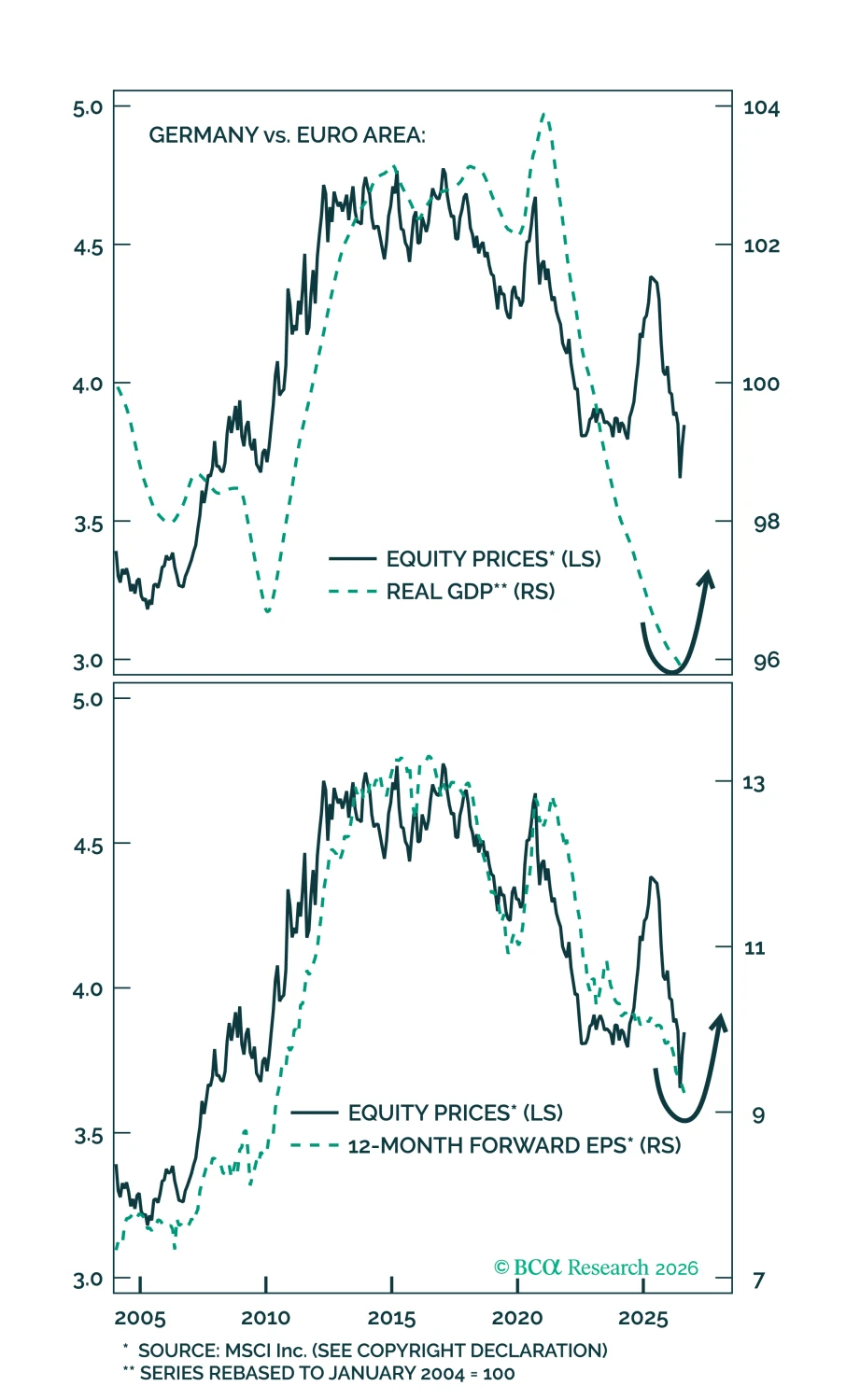
Germany’s equity market is becoming a more interesting cyclical opportunity, although the near-term backdrop remains challenging. Share prices have weakened relative to the economy and expected earnings, leaving valuations more attractive if growth firms and policy support gains traction.
A more expansionary fiscal stance, tax relief, quicker permitting and lower regulatory burdens could lift domestic demand and business investment. Higher spending on infrastructure, defence and energy security would also support industrial, engineering and construction activity. Most market forecasts point to a gradual recovery through 2026–27, though energy prices and trade disruption remain key risks.
Source: BCA Research
The recovery is unlikely to be uniform. Export-heavy manufacturers remain vulnerable to softer global demand, US trade policy and Chinese competition, while higher Bund yields may limit valuation expansion. The stronger opportunities are likely to lie in domestic-facing businesses, infrastructure and defence beneficiaries, selected financials and quality industrial companies geared to a revival in European capital spending.
Still, the timing is not yet compelling. The global energy shock, uncertainty around trade policy and higher sovereign yields all argue against an aggressive tactical overweight in German equities or duration today.
The appropriate stance is therefore neutral tactically on German equities and Bunds while oil, inflation and the bond sell-off remain the dominant drivers. The AfD result adds momentum to a policy reset centred on stronger growth, lower regulatory barriers and improved competitiveness. If Berlin responds with credible fiscal support and supply-side reform (and if energy pressures abate) Germany could move from Europe’s chronic underperformer to one of its more compelling recovery opportunities.
First published on LinkedIn, 17 September 2026.