
Adam Smith’s invisible hand was never meant to wear a Stars and Stripes glove, yet for decades, it effectively did.
American power hard‑wired the global economy, and the Hormuz shock has reminded investors just how fragile that wiring has become. In a world where the hegemon is less willing or able to underwrite stability, South African investors, in particular, need to rethink how they manage risk, inflation, and diversification.
For decades, the physical and financial plumbing of the global economy was built on the assumption that the United States would keep sea lanes open, backstop allies, and absorb exports from the rest of the world. Energy routes, defence postures, and manufacturing hubs all evolved around that implicit guarantee.
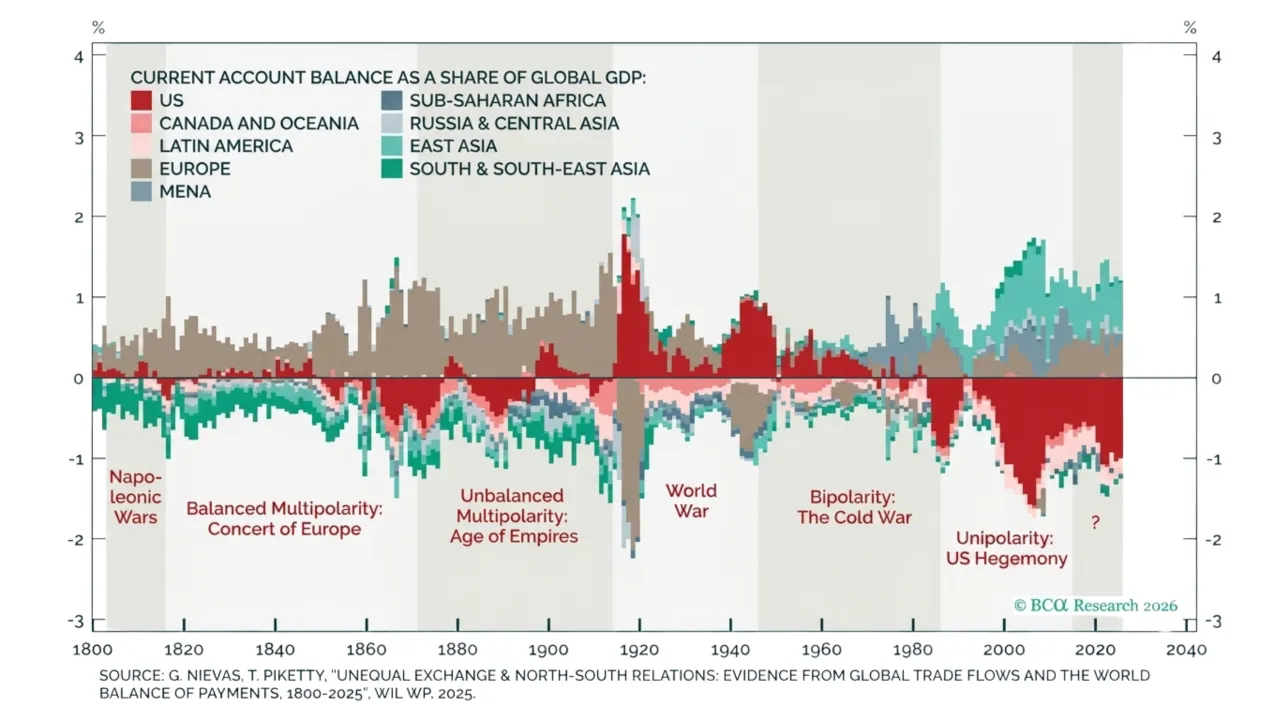
The accompanying graph from BCA Research traces the ebb and flow of global economic power from the 1800s through to the projected 2040s, showing how successive empires have shaped each era before the United States emerged as the dominant hegemon in the late 20th and early 21st centuries.
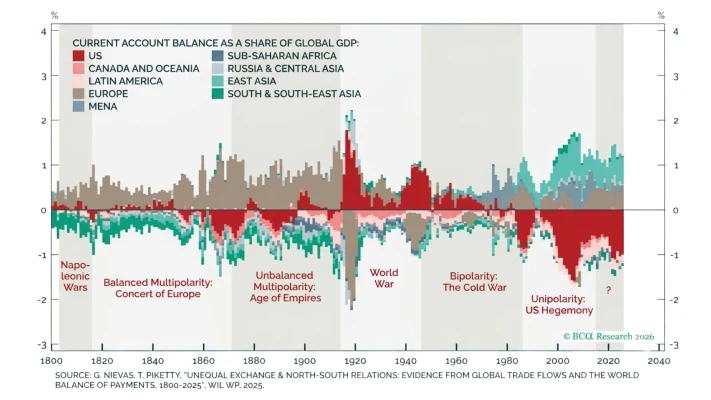
Notably, American dominance was not just geopolitical - it was deeply financial. As the dollar essentially functions as the world’s reserve currency and US markets are deep and trusted, the US has been able to run a persistent current account deficit (importing far more than it exports) while the rest of the world accumulates dollar assets like Treasuries and equities.
In effect, that deficit is the financial expression of hegemony: it anchors global trade and capital flows around the dollar, ties foreign balance sheets to US stability, and reinforces Washington’s central role in shaping the system’s rules.
That is why so many strategic vulnerabilities today can be traced back to “because… America.” German defence underinvestment, Gulf producers’ dependence on the Strait of Hormuz, China’s dominance in manufacturing, Australia’s fuel logistics, and Canada’s infrastructure tied to US demand all reflect a world optimised for a single, reliable hegemon.
The Hormuz War of 2026 delivered a stark lesson: no supply chain is truly safe. Even if full‑scale global war remains unlikely under a mutually assured destruction equilibrium, the inflation impulse is very real. Early in the crisis, the working assumption was that higher oil prices would be short‑lived or self‑defeating- demand destruction in a recession would pull prices down and make longer‑dated contracts cheap.
Instead, the conflict has settled into an uncomfortable middle ground, where neither resolution nor total disruption prevails. Long‑dated Brent (for instance, December 2026 contracts are still trading around 85 USD) now carries meaningful upside risk. That risk is driven not just by current disruptions, but by what comes after: the need to rebuild and expand strategic reserves, especially in countries that entered the crisis underprepared.
What makes this moment unusual is that the world’s infrastructure and institutions are still wired for American leadership, just as the US begins to behave more like a “normal” power- guided less by system-wide stability and more by narrow self‑interest. That mismatch between old wiring and new behaviour is precisely why geopolitics is no longer “transitory” in macro terms.
For South African investors, the implications are concrete. Imported inflation poses a persistent risk, driven by higher, more volatile energy prices, disrupted trade routes, and currency swings. Portfolio correlations can spike unexpectedly as global shocks ripple through commodities, emerging‑market risk premia, and the rand. The old habit of leaning heavily on US‑centric assets as a stable anchor becomes less reliable when the hegemon itself is reassessing its role
In this kind of environment, it makes less sense to think in terms of “safe” versus “risky” assets. A more useful lens is regimes: inflationary shocks, supply disruptions, and prolonged geopolitical standoffs. That change demands strategies that can adapt, rather than static allocations tied to a single macro narrative.
This is exactly where hedge funds come into their own and, frankly, why they become such an easy sell in periods like this. When the macro backdrop is calm, the value of flexibility is harder to see. When shocks become the norm, it becomes obvious.
Hedge funds can go long and short across asset classes, trade volatility, commodities, and currencies, and actively hedge inflation and tail risks in ways traditional long‑only portfolios cannot. They are also better equipped to pivot as narratives evolve- from “oil shocks are temporary” to “energy is structurally repricing”- without being constrained by benchmarks.
For South African investors navigating a more fragmented and less predictable global order, that flexibility matters. Hedge funds offer diversified return drivers beyond local equities and bonds, tools to manage drawdowns during geopolitical shocks, and the ability to monetise dislocations created by the system’s growing fragility.
In a world where no supply chain (and no hegemon for that matter) can be taken for granted, that is not a luxury. It is core risk management.
First published on LinkedIn, 2 June 2026.