
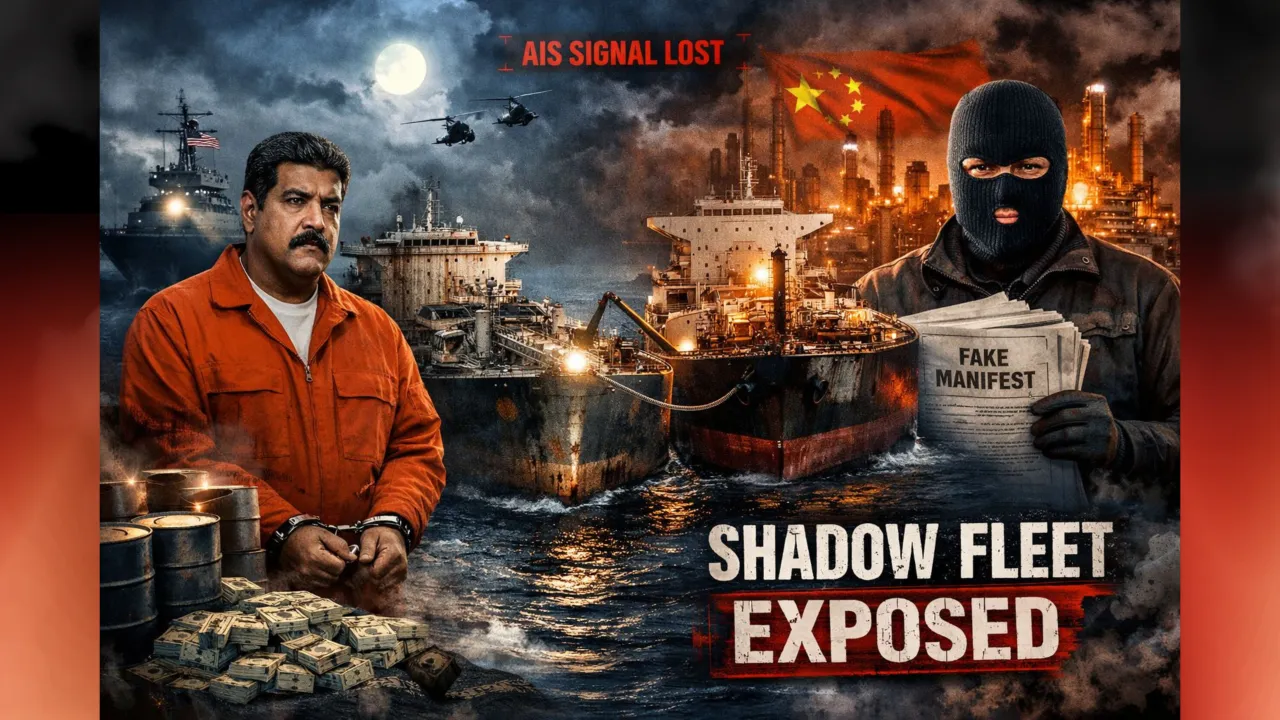
At 2am, somewhere off a warm coast, a tanker “disappears” without actually going anywhere.
Its AIS (Automatic Identification System) signal flickers off or reappears hundreds of nautical miles away. Ownership traces back to a shell company in an unfamiliar jurisdiction.
Its flag has changed- again. A ship-to-ship transfer takes place just beyond territorial waters, and by morning, the cargo is no longer “Russian” or “Venezuelan” on paper.
No, I didn’t just describe a new Netflix series. This choreography captures the true nature of the shadow fleet in 2026: not a single armada, but a constantly shifting logistics ecosystem designed to keep sanctioned oil moving through a world that officially says it shouldn’t.
What has dragged this system into sharper focus is Venezuela.
The Venezuelan crisis is no longer just a political drama. It is exposing structural vulnerabilities across the very networks that move Russian, Iranian, and Venezuelan barrels under sanctions.
These rising frictions (higher costs, greater interception risk and shrinking ambiguity) feed directly into global supply dynamics.
The recent US capture of Venezuelan President Nicolás Maduro is shocking at face value, but its significance runs deeper than the headlines. It has opened a can of worms, with consequences rippling through energy markets, geopolitics, and financial systems. What looks like a dramatic political moment is, in reality, a stress test of the shadow-trade architecture that has sustained sanctioned oil flows for years.
To understand why, you need a clear sense of how the shadow fleet actually functions.
The shadow fleet is not a secret navy or a centrally controlled fleet of ships, but rather an informal but highly organised network of ageing tankers, opaque traders, shell-company owners, and alternative insurers. These vessels operate in the grey zone- technically compliant enough to avoid immediate interdiction, yet structured to conceal ownership, financing, and cargo origin.
This system exists because the modern oil trade relies as much on services as on barrels. Western insurers, shippers, classification societies, and financiers traditionally provide the plumbing of global energy logistics. When sanctions strip those services away, sanctioned producers don’t stop exporting- they build parallel systems using old tankers, flag-hopping registries, spoofed AIS signals, and ship-to-ship transfers to keep oil moving.
AIS manipulation and false paperwork aren’t anomalies; they are the business model. By obscuring origin and intent, the shadow fleet shifts enforcement costs onto regulators and navies, who must prove intent across jurisdictions
For Russia, this system has become indispensable.
Energy revenues remain the backbone of its war economy, even as price caps and shipping restrictions tighten. Logistics rerouting has kept Russian flows moving (mainly to Asia) albeit at higher discounts and costs.
Western policy is catching up. Europe is hitting maritime services and shadow-fleet vessels with expanded sanctions. The United States increasingly frames the shadow fleet as a deliberate sanctions-evasion architecture rather than clever arbitrage, lowering the threshold for more assertive enforcement.
This is where Venezuela becomes central rather than peripheral.
In headline terms, Venezuelan production is small: roughly 1% of global supply. However, oil markets run on quality as well as quantity. More than two-thirds of Venezuela’s output is heavy, sour crude- exactly the segment that is structurally tight and difficult to replace. While its total volume is small, Venezuela accounts for about 4.5% of global heavy-crude production, a category crucial for diesel yields.
Heavy crude is not easily substituted.
Canada, Mexico, and Russia are among the few suppliers capable of producing similar grades at scale. That scarcity matters because diesel remains the backbone of freight, agriculture, mining, and industrial activity. The world learned this in 2022, when Russia’s invasion exposed how quickly diesel margins can spike even without outright supply collapse.
Venezuelan barrels, in other words, punch far above their weight. Prolonged disruption doesn’t necessarily trigger a crude price shock- but it can destabilise diesel markets, refining margins, and regional spreads.
Interestingly, those effects would be felt most acutely in China. Since 2019 sanctions, China has become Venezuela’s dominant customer.
Heavy Venezuelan crude suits its independent refiners, who rely on dense feedstocks for secondary conversion. By late 2025, over 80% of Venezuela’s exports reportedly headed to China, mostly via shadow-fleet tankers. The US has already intercepted several such vessels in the Caribbean.
These actions are raising voyage risk, increasing insurance costs, and tightening the logistics chain between Venezuela and China. If pressure intensifies, Venezuela’s ability to supply China could drop sharply. The impact would be felt not through headline crude prices, but through refining economics: tighter heavy-crude balances, stressed diesel markets, and more volatile grade differentials.
Russia’s presence in Venezuela is neither new nor superficial. Through Rosneft (a company that serves as both Russia’s largest oil producer and a geopolitical instrument), the Kremlin has maintained strategic influence where Western majors have withdrawn.
When US sanctions isolated PDVSA (Petróleos de Venezuela, S.A., is the state-owned oil and gas company of Venezuela), Rosneft-linked entities stepped in to market Venezuelan crude and organise logistics. Even when Washington sanctioned Rosneft’s trading arms, Russia restructured rather than exited its joint ventures.
This matters for two reasons. Firstly, Rosneft understands sanctioned logistics. It knows how to move barrels when insurance dries up, documentation becomes a liability, and ports close.
Secondly, shadow networks overlap. Russian, Iranian, and Venezuelan flows increasingly rely on the same ageing vessels, alternative insurers, and opaque owners. Pressure on Venezuelan routes, therefore, reverberates across the entire sanctioned-oil ecosystem.
The rise of the shadow fleet is not a failure of sanctions, but rather a reflection of the current macro-economic environment: persistent global oil demand, political aversion to supply shocks, and inconsistent enforcement.
However, 2026 feels different. Europe is tightening rules. The US is moving from paperwork to patrol boats. Sanctioned states are doubling down on alternative systems.
As Venezuelan disruptions send shockwaves through the shadow fleet, investors should expect volatility rather than resolution.
The clearest beneficiaries sit downstream. Refining powerhouses such as Valero Energy and Marathon Petroleum are well-positioned as heavy-crude shortages tighten diesel markets and push up processing premiums.
Refining margins could expand materially (potentially by 10–20%) as constrained heavy supply collides with inelastic diesel demand.
A key signal to watch is the Brent heavy-sour spread, which measures the price gap between Brent and heavier grades such as Venezuelan crude. As heavy supply tightens, these spreads could widen to $5-7 per barrel, amplifying price swings across refined products.
OPEC+ intervention may temper the most extreme spikes, but it is unlikely to eliminate volatility. The broader takeaway is clear: this environment rewards investors who understand second-order effects. The real action lies not just in crude prices, but in refining margins, diesel futures, and the plumbing of energy markets now operating with far less ambiguity than before.
If you want to understand where geopolitics is heading, don’t start with summit communiqués or headline speeches. Start with heavy crude, diesel balances, and AIS signals that go dark in the middle of the night.
First published on LinkedIn, 20 January 2026.