
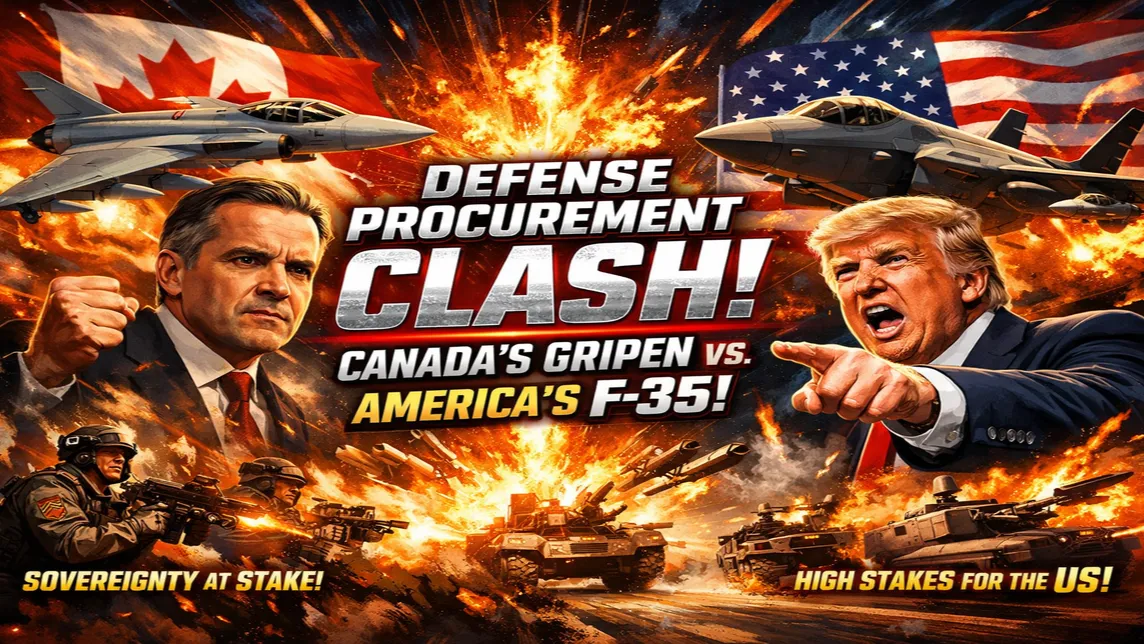
President Trump may soon discover that geopolitical chest-thumping comes with a very real invoice.
Canada’s Prime Minister, Mark Carney, is running out of patience with Washington’s theatrics. That irritation is now spilling into one of the most sensitive arenas in geopolitics: defence procurement.
Canada is planning a once-in-a-generation upgrade to its air force -up to 88 new fighter jets, one of the largest defence purchases in its history. For years, the default option has been the US-built F-35, the stealth backbone of NATO air power. However, there’s a catch, and a sizeable one at that.
The F-35 comes with strict US control over its operating system and software architecture. Buyers don’t get full sovereignty over mission data, software upgrades, or system customisation. In plain English: you fly the jet, but Washington still holds the keys. That’s not a technical footnote, it’s a strategic constraint on the part of the US.
Enter Sweden’s Saab JAS-39 Gripen E/F. It is NATO-compatible, combat-proven, cheaper to operate, and critically offers full systems access and customisation to the purchasing country. For middle powers seeking strategic autonomy, that distinction is decisive. Control over data, upgrades and mission parameters is no longer optional. It is sovereignty.
Trump’s increasingly combative posture toward allies (think including tariff threats, public browbeating, and transactional diplomacy) has materially raised the political cost of buying American hardware. Canada is not alone in quietly reassessing what “strategic alignment” really means in a Trump-led world.
If Ottawa walks away from the F-35, the consequences for the US would be material. Tens of billions of dollars in aircraft sales, decades of maintenance contracts, and deep supply-chain spill overs would be at risk. More importantly, the US would lose something harder to quantify: influence embedded in allied militaries through hardware dependence.
This is the risk of confusing volume with power. Defence procurement decisions lock in relationships for decades. Alienate allies today, and you don’t just lose goodwill- you lose orders, leverage, and long-term strategic embeddedness.
For investors, this is not political theatre. It signals a structural shift already visible across markets: de-risking away from US political unpredictability. Capital is rotating, not retreating-as visible in energy contracts, trade settlement, industrial policy, and now defence.
The investable theme is defence sovereignty:
• Allies are prioritising systems that offer operational control, software independence and political neutrality.
• That shift favours non-US defence suppliers, particularly in Europe, over large, crowded incumbents.
At AG Capital, we believe this translates into targeted European exposure. Eutelsat stands out after France injected €1 billion at a premium, underlining its national-security relevance as a European satellite alternative. Avio offers similar asymmetry: Europe’s independent rocket manufacturer, profitable, strategically vital, and trading at roughly 2.5× sales.
The takeaway is simple. Trump’s foreign-policy style may play well domestically, but markets care about repeatability and reliability. When allies start pricing political risk into procurement decisions, investors should do the same.
Defence, once again, isn’t just about weapons- it’s about who you trust to hold the kill switch.
First published on LinkedIn, 28 January 2026.