
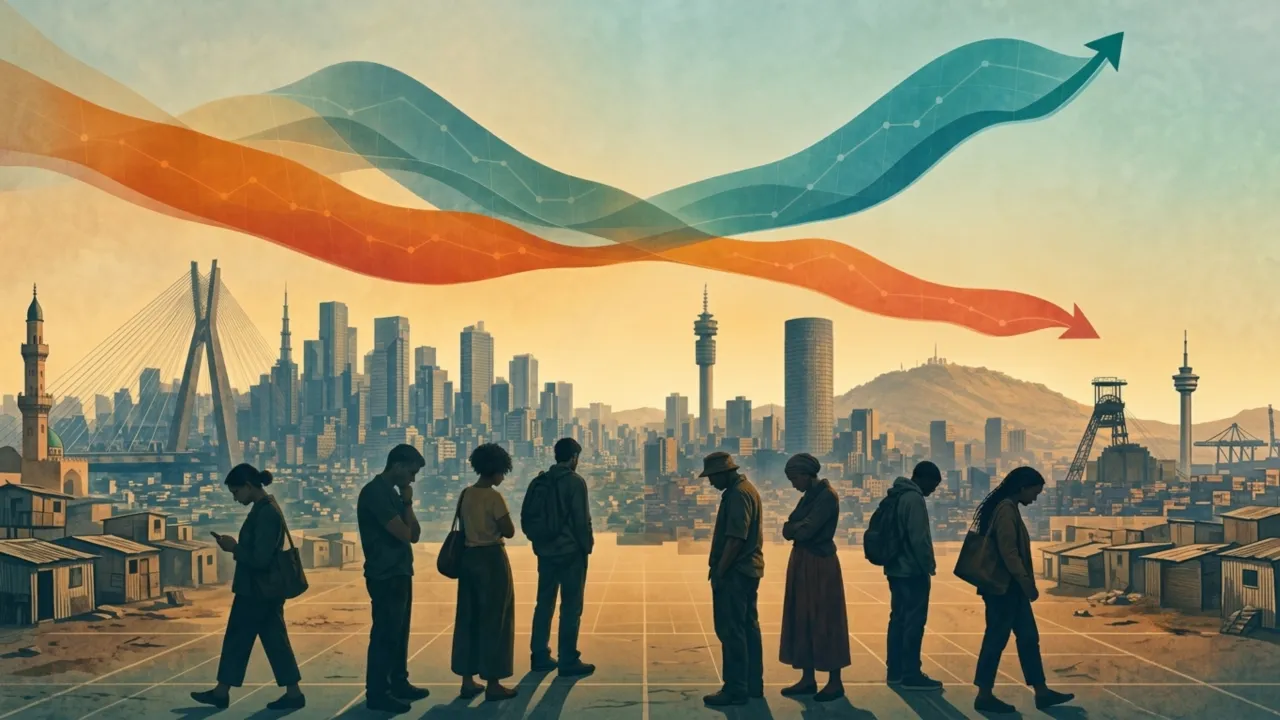
Brazil offers a useful warning for governments tempted to govern by mood rather than mandate.
On paper, its economy is doing remarkably well. GDP has grown at around 3% for three consecutive years, inflation has fallen back towards 4%, and unemployment is at historic lows.
Nevertheless, roughly half of Brazilians say the economy has worsened over the past year, while only one in four believes it has improved. The disconnect between data and sentiment is stark and politically dangerous.
This phenomenon has adopted a Gen-Z-style moniker in recent years: the “vibecession.” In simplistic terms, it describes a situation where economic indicators point one way, but public mood pulls firmly in the other. It is less about what the economy is doing in aggregate and more about how it feels in households and businesses.
South Africa’s latest GDP figures (released on the 9th June) arrived against this backdrop. According to Statistics South Africa, real GDP for the first quarter of 2026 grew by 0,5% QoQ seasonally adjusted. This followed a 0,4% QoQ expansion in the final quarter of 2025. That marks the sixth consecutive quarter of positive growth, a run that would have been hard to imagine during the worst of load shedding and pandemic-era disruption.
By the standards of a low-growth, structurally constrained economy, that is far from trivial. Finance, agriculture, trade and transport all contributed positively to output, while the expenditure side was supported by firmer household consumption, government spending, and exports. In other words, the engine is running- perhaps not fast, but at least in the right direction.
Yet, if you ask many South Africans how the economy is doing, the answer you get will sound far closer to Brazil’s mood than to the GDP tables. For most people, the economy is not a quarterly print. It is whether they can find a job, whether their pay covers groceries and transport, whether the lights stay on, and whether they sense that things are getting better or simply drifting sideways.
That gap, where the neatness of the data peels away from the messiness of lived reality, is precisely what invites trouble.
When governments see upbeat or stabilising macro data alongside sour public sentiment, the instinctive response is often to reach for the tools of narrative. They try to “tell the good story”: emphasise the six consecutive quarters of growth, highlight improved electricity supply, and point to signs of recovery in logistics and rail. None of that is untrue. However, when messaging becomes the main response to a pessimistic public, policy starts to drift away from the structural agenda and towards mood management.
Brazil is a cautionary tale of where that road can lead. Despite strong headline numbers, its government now faces an electorate that simply does not feel the effects of the recovery. The “vibecession” there is not just a communications problem; it is a sign that macro gains have not translated into broad-based, tangible improvement. Winning the news cycle has turned out to be a poor substitute for building durable confidence.
South Africa risks something similar if we treat this latest GDP print primarily as an opportunity to claim momentum rather than as a reminder of how far there is to go.
The structural agenda is not a mystery. Energy security, logistics reform, crime and corruption, the performance of state-owned enterprises, skills and education- all of these shape the economy’s potential growth rate and, ultimately, whether a 0,5% quarterly gain feels like a turning point or a rounding error. They also determine whether growth is inclusive enough for ordinary households to connect the dots between national statistics and their own bank balances.
South Africa’s six consecutive quarters of expansion are indeed welcome, and they matter for investors, ratings agencies and fiscal planners. However, voters tend to judge the economy on a different set of metrics: job prospects, service delivery, crime, and the reliability of day-to-day infrastructure. If those do not improve meaningfully, even a technically impressive growth run will feel hollow.
The risk is that policymakers start designing interventions around perception rather than around these fundamentals. That can take many forms: short-term relief measures that briefly soothe discontent but do not shift productivity; ad hoc bailouts that keep failing entities afloat without reform; or policy reversals every time a new survey shows rising pessimism. Over time, the structural agenda gets crowded out by a series of tactical moves aimed at buying time.
The irony is that this approach deepens the very problem it is meant to solve. If energy reform stalls, logistics clog up again, or crime continues to deter investment, the economy’s ceiling remains low. Growth then struggles to break out of its current 1–2% annual range, and each quarter becomes a fresh battle to spin marginal improvements into “good news”. Sentiment, understandably, stays fragile.
Brazil’s experience suggests that once the gap between macro data and public mood widens, it is hard to close it with messaging alone. What ultimately changes sentiment is not a press conference or a slogan, but a series of concrete, felt shifts: a job found, a small business that can trade without constant power cuts, a train that runs on time, a sense that the next year might be slightly better than the last.
South Africa’s Q1 2026 GDP print should therefore be read in two ways. On one level, it is encouraging evidence that the economy has avoided an outright recession and can sustain modest growth despite global headwinds.
On the other hand, it is a reminder that this kind of growth, while better than contraction, is not transformative on its own. Trying to sell it as such risks a Brazilian-style vibecession.
The choice facing policymakers is whether to spend the next few years arguing that 0,5% here and 0,4% there amount to a recovery, or whether to use this period of fragile momentum to double down on reform. Only the latter can narrow the gap between what the economy does and how it feels.
Brazil is discovering that you can manage sentiment for a long time and still find yourself with an unhappy electorate. South Africa still has an opportunity to do it the hard way: fix the structure first, and let the vibes follow.
First published on LinkedIn, 17 June 2026.