
When politicians promise to “shield families from soaring energy bills,” they’re really deciding who ends up with the stomach ache. In this latest energy shock, households have been spared the worst of the pain upfront- but investors are increasingly being served the after-effects through swollen deficits, murkier balance sheets, and stickier inflation. Where support leans heavily on subsidies and tax cuts, you should be thinking about higher medium-term fiscal and sovereign risk. Where policymakers rely more on price adjustments, monetary tightening, or demand management, the trade-off tilts toward political strain, weaker growth, and more volatility in local assets.
For investors, the key question is no longer simply how governments cushion the shock, but who ultimately pays- bondholders, equity holders, or households.
In many advanced and some emerging economies, the initial instinct has been to move the pain from consumers’ pockets onto public balance sheets. Large support packages have been rolled out quickly, often branded as temporary but with hazy end dates and limited transparency on their true fiscal cost. That’s precisely how one-off crisis measures can harden into structural spending.
From a sovereign-risk perspective, three issues follow:
• Deficits can drift wider as broad subsidies and tax cuts get extended, just as higher interest rates are already pushing up debt-service costs.
• Shorter average maturities in government debt mean those higher rates feed through faster, amplifying the impact of any slippage.
• Price caps and artificially low tariffs can quietly shift losses onto state-owned utilities and other public entities, only to resurface later as recapitalizations or called guarantees.
Put simply, generous energy support is not just a social safety-net choice. For fixed-income investors, it’s a credit variable that should feed directly into how spreads are priced and how much duration risk they are comfortable taking.
Moreover, it is worth bearing in mind the relative divide between energy exporters and importers. Producers benefiting from elevated oil and gas prices can afford to run larger support schemes and even broader fiscal expansions for now, financed out of windfall revenues. That typically tends to support local bonds and equities in the near term and dulls the immediate stress on households and firms.
Energy-importing emerging markets however, especially in parts of Africa and Asia, simply don’t have that luxury. With tighter financing conditions, weaker currencies, and high debt-service burdens, they’ve had to rely more on partial price pass-through, formula-based adjustments, and demand-side measures such as rationing or conservation campaigns. That approach protects solvency but shifts more of the adjustment onto real incomes, which investors need to translate into higher inflation risk, softer growth, and a greater chance of social or political flare-ups. For commodity-importing sovereigns whose terms of trade have deteriorated, rollover and funding risks naturally move higher up the watch list.
Inflation and rates: the “hidden beta” of subsidies
There’s also a subtler, global angle. When many countries hold down domestic energy prices at the same time, demand doesn’t fall as much as it would in a fully market-driven system. The result is tighter global energy markets for longer and a more persistent inflation impulse than headline pass-through might suggest.
For rates markets, that creates a kind of hidden beta to the conflict and the energy shock. Inflation expectations become stickier, especially where energy and food make up a large share of the consumption basket. Term premia are more prone to overshoot as markets struggle to distinguish between a one-off price spike and a shift toward a more subsidy-heavy fiscal reaction function. On the equity side, producers and upstream energy names stand to benefit from sustained higher prices, while energy-intensive sectors (transport, heavy industry, lower-margin retailers) face ongoing margin pressure unless they can consistently push costs onto consumers.
Policy mix as signal: which constraint bites first?
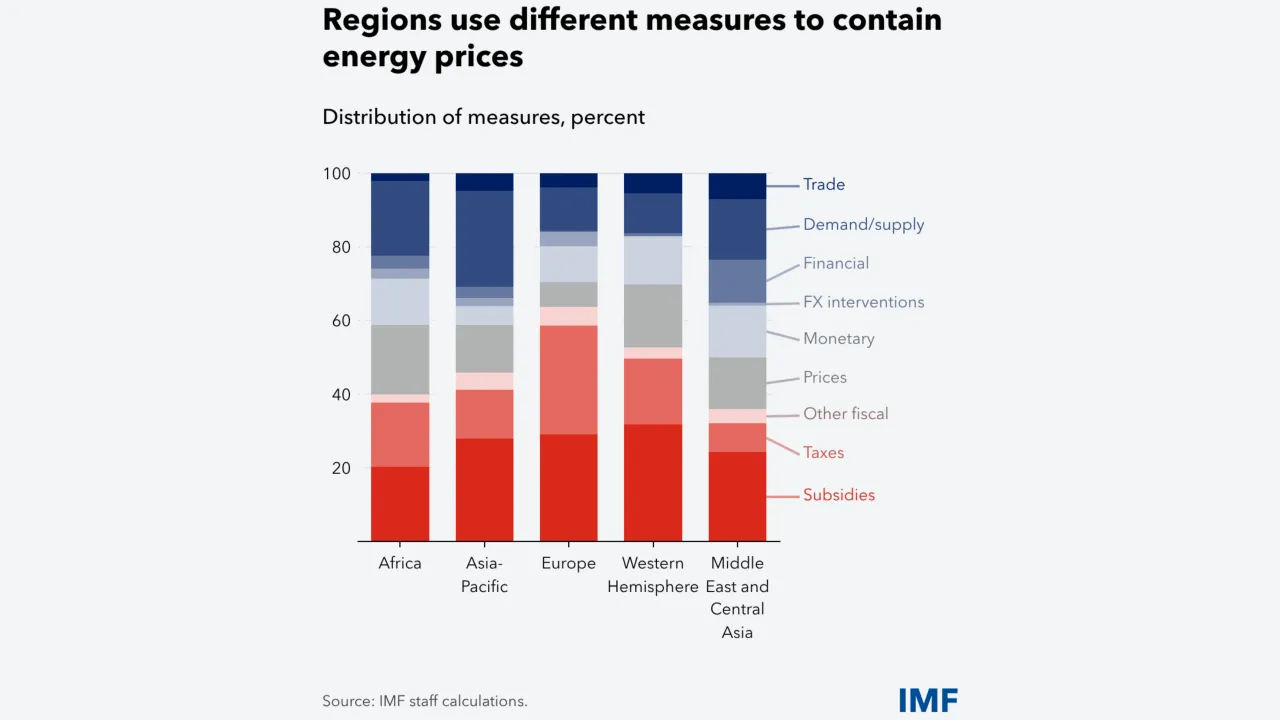
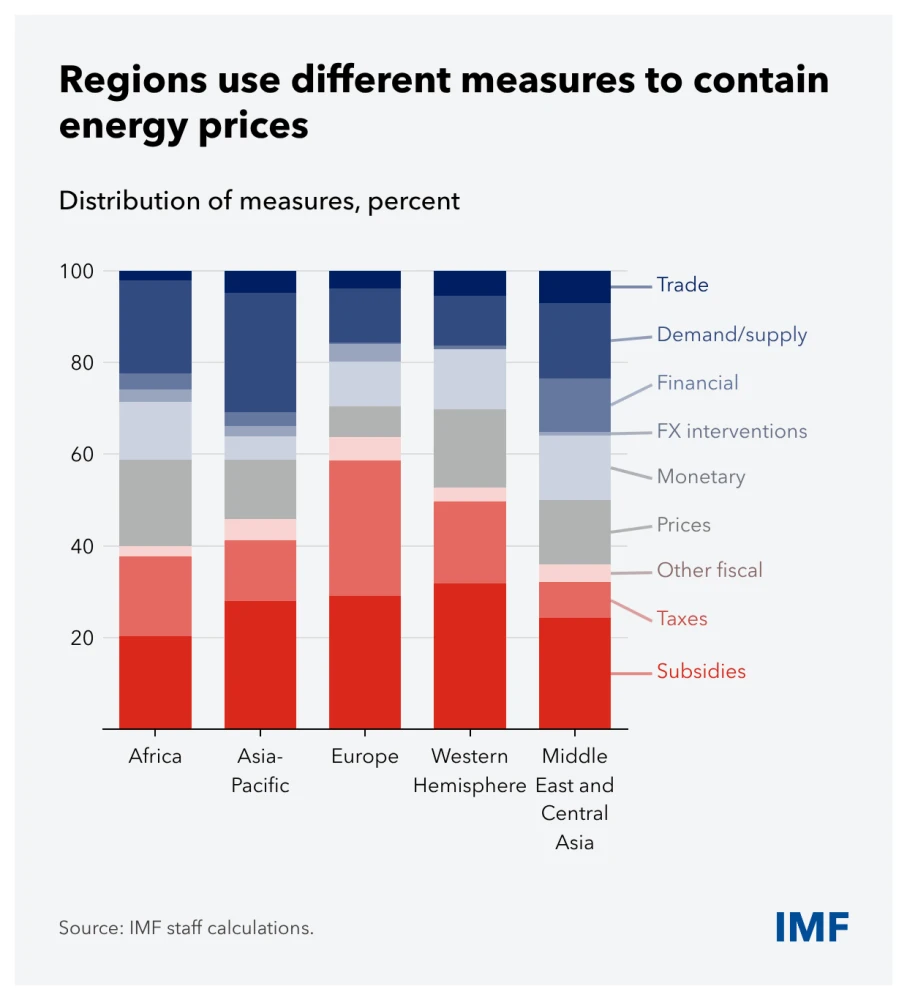
For investors, the composition of each country’s policy response effectively signals which constraint is likely to bind first. Where broad subsidies, tax cuts and other fiscal tools dominate, governments are clearly prioritizing near-term growth and social stability over balance-sheet purity. That can be supportive for risk assets in the short run, but it raises questions about how the eventual bill will be settled: through future tax increases, spending cuts, or tighter market access when refinancing comes due. Credit analysts will be paying close attention to how rating agencies talk about off-budget support and contingent liabilities in these jurisdictions.
Where the response leans more on administered price increases, tighter monetary policy, and demand-side measures, the message is different. These governments are more willing to allow relative prices to move and to use the policy rate or rationing to cool demand. That usually leads to cleaner medium-term debt dynamics, but at the cost of more volatile growth and a noisier political backdrop. In those cases, institutional quality and policy credibility become just as important as headline debt ratios when assessing risk premia.
Source: IMF staff calculations
Portfolio implications: where to lean in, where to be cautious
If you translate the IMF’s “protect people, not prices” mantra into positioning, you end up with a fairly clear guide for risk-taking.
• In sovereign credit, be cautious with names that combine high debt, short maturity profiles, and a heavy reliance on broad, open-ended energy support. Those stories are most at risk of “temporary” measures morphing into structural strain. Favour countries that are already shifting toward more targeted transfers and allowing domestic prices to better reflect global benchmarks, even if that path is politically bumpy; over time, those tend to be the cleaner debt-sustainability stories.
• In EM FX and local rates, energy-importing economies that are trying to hold the line on domestic prices are more exposed to sharper currency adjustments later if investors begin to doubt the sustainability of the regime. Central banks in those markets may be forced to keep real rates high to offset fiscal largesse, which can support the currency but weigh on growth-sensitive assets.
• For equities, state-owned or heavily regulated utilities in generous support regimes deserve close scrutiny for hidden balance-sheet risks and political constraints on pricing. By contrast, energy-exporting countries that pair current windfalls with credible fiscal frameworks and robust savings mechanisms are better positioned to turn prolonged higher prices into a tailwind without immediately undermining their credit quality.
Ultimately, this energy shock is no longer just about barrels, shipping lanes, and headline oil prices. It has become a real-time test of how far governments are willing to stretch their balance sheets to protect households and firms from repeated external shocks. For investors, understanding that trade-off is central to where you own duration, where you take spread and equity risk, and where to remain cautious until the outlook for subsidies and fiscal exit strategies becomes clearer.
And as long as governments keep swallowing more of the shock, markets should expect the indigestion to linger- showing up as choppier spreads, more sensitive curves, and periodic bouts of risk aversion whenever the next policy “meal” looks too big to digest.
First published on LinkedIn, 23 June 2026.