

Anglo American walking away from De Beers sounds, on the surface, like just another portfolio tidy‑up in a difficult market. However, if you follow the money - from Johannesburg to Gaborone to Riyadh - it starts to look more like a slow, subtle redraw of who actually carries long‑dated resource risk in the global system.
As such, Anglo American’s looming exit is not just a corporate reshuffle; it is a stress test for diamond‑dependent governments that have built fifty‑year plans on top of De Beers’ pricing discipline. Anglo’s payout matters far less than what Botswana and Namibia are left holding when the world’s most recognisable diamond brand changes hands - and whoever buys it decides whether the old obligations still apply.
De Beers CEO, Al Cook, has been unusually blunt: a sale is closer than ever and likely a matter of “weeks rather than months.” That clarity arrives at a brutal point in the cycle. Natural diamond prices are well off their 2022 peaks, and lab‑grown stones have seen prices collapse by roughly three‑quarters in about five years, obliterating much of the premium mined diamonds once enjoyed.
In Gaborone and Windhoek, diamond prices are anything but an abstraction: Botswana still depends on them for the bulk of export earnings and a large share of fiscal revenue, while Namibia’s more diversified basket nonetheless leans heavily on diamond‑linked taxes and royalties.
When rough prices slip, the damage to budgets and the balance of payments shows up quickly, and over the past decade, the two economies have tended to move together whenever the diamond cycle has turned. Both felt the shock in 2015’s price slump and again in 2020, when COVID‑19 hammered global luxury demand and dragged growth sharply lower in each case.
Since then their paths have started to diverge, with Botswana’s real GDP contracting in 2024 even as Namibia expanded on the back of emerging oil and gas. Beneath the surface, the export data helps to clarify this trend: Botswana’s diamond share has eased from roughly 79% to about 68% as copper comes through but remains extremely concentrated, whereas Namibia’s dependence sits nearer 30–35%, with uranium now doing more of the heavy lifting as diamond output softens.
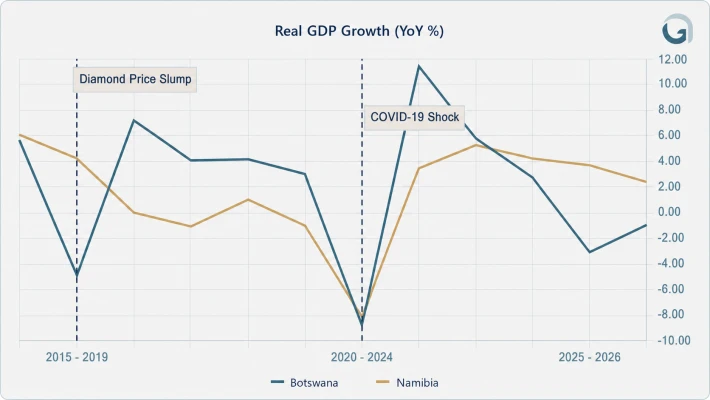
Source: Bloomberg, AG Capital
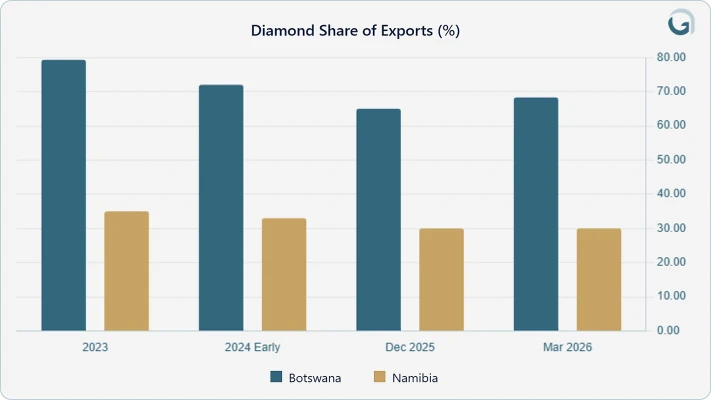
Source: Bloomberg, AG Capital
The game stays in balance because of one core mechanism: the De Beers sightholder model. Instead of tossing all production into a spot market, De Beers allocates rough stones to a small group of approved buyers at administered prices and at set intervals. That controlled‑supply approach irons out price swings and has historically kept rough prices higher and more predictable than a free‑for‑all market would.
Botswana’s Debswana joint venture is where that market power meets the state’s balance sheet. Debswana (a 50:50 partnership between the government and De Beers) produces most of Botswana’s diamonds.
After a long and often tense renegotiation, the two sides agreed on extended mining licences, a rising share of Debswana output to be marketed through Botswana’s own Okavango Diamond Company, and funding commitments to push diversification. Gaborone has effectively hard‑wired De Beers’ pricing clout into its national development plan.
From Anglo’s perspective, quitting diamonds is straightforward: it is a structurally challenged business that adds complexity and volatility to a portfolio the group wants to simplify. For whoever buys in next, though, the incentives are very different.
You don’t have to blow up the sightholder system to change the economics. Loosen it a little - push more volume onto tenders, chase market share more aggressively, run inventories down to juice cash flow - and rough prices will drift toward the floor created by cheap lab‑grown alternatives. With synthetics trading at a deep discount and natural stones already repriced lower, upside for mined diamonds is capped unless someone sacrifices volume to defend price. A new owner who has just written a large cheque may find that a hard sell.
For Botswana and Namibia, where royalties, taxes and foreign‑exchange inflows move almost point‑for‑point with the diamond market, that is where the real leverage lies. It is not just about who “owns” the supply chain once Anglo leaves, but whether that owner still manages rough supply carefully with producer governments or simply treats it as stock to monetise.
Most of the commentary still treats this purely as an Anglo story - a bit of portfolio housekeeping, some balance‑sheet de‑risking, and value extraction from a troubled asset. That might be tidy from an equity perspective, but it largely ignores the sovereign dimension.
Botswana’s investment‑grade rating and its sovereign wealth fund are anchored to the idea that diamond cash flows will remain fairly steady, and that depletion will be managed over time. If rough prices take a structural step down because De Beers’ new owner is less willing to choke supply, that cuts straight into Botswana’s macro story. It is not just export receipts that suffer; it is the entire model of using diamond rents to fund diversification and build buffers.
Yet African sovereign spreads hardly reflect this. Botswana still trades as if its main dangers are politics and generic risk‑off moves, not the possibility that its key revenue stream has lost pricing power. The disconnect between how equity markets are treating Anglo’s exit and how bond markets are treating Botswana’s dependence is exactly where the mispricing lives.
Against that backdrop, Saudi Aramco is taking a very different tack. Aramco is exploring a string of asset sales - from midstream infrastructure to stakes in non‑core businesses like sulphur and power - with the goal of raising tens of billions of dollars for the Saudi state. The logic in Riyadh is to monetise parts of the resource complex more aggressively while oil prices are still supportive, using capital markets to front‑load cash for an ambitious domestic agenda.
Looked at together, the De Beers and Aramco stories are two versions of the same trend: resource‑linked sovereigns and their corporate partners are reshuffling who carries long‑term commodity risk, and they are doing it through transactions rather than treaties.
Aramco’s disposals shift future cash flows from the public sector into private or quasi‑private hands in exchange for upfront proceeds. Anglo’s exit from De Beers does the reverse: it pulls a diversified international group out of a structure that has long underpinned African sovereign finances and hands the keys to whoever turns up with the winning bid.
Both moves sit under the same theme: the old bargain - predictable resource rents in exchange for political and regulatory stability - is being renegotiated deal by deal.
For investors, the task now is to look through the headlines about “portfolio optimisation” and “value creation” and ask a more uncomfortable question: who is actually left holding the long‑dated commodity risk when the music stops?
First published on LinkedIn, 30 June 2026.