
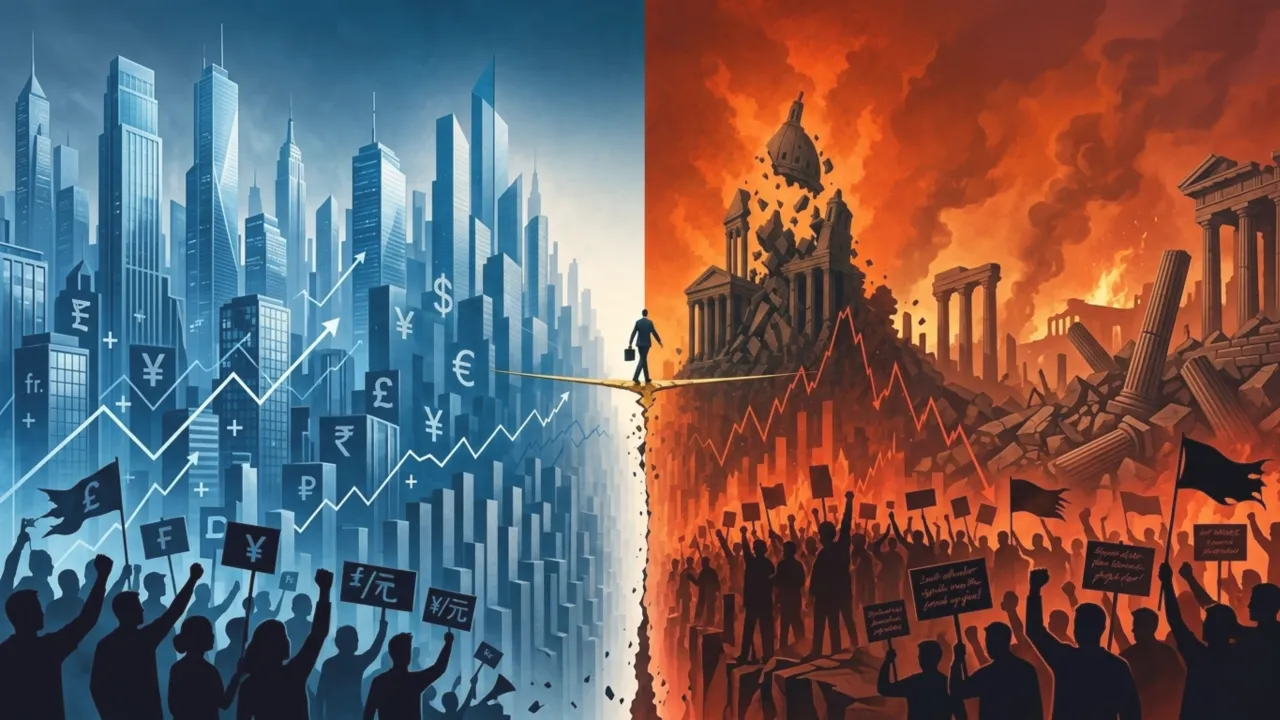
The collapse of centrist politics isn’t just a political change; it’s a fault line running through global markets. As South Africans, it’s easy to tune out the noise of international politics; after all, our own political landscape has made us somewhat desensitised. However, for investors, that distance is an illusion. From where we stand, we’re far closer to the crack than we might realise.
For decades, centrist politics acted like a kind of stabiliser. Policies moved slowly, institutions held, and markets could price in a reasonable degree of predictability. That world is fading. In its place, globally we’re seeing a sharper divide between the far left and the far right, and that shift is starting to ripple through financial markets in ways investors can’t ignore.
At the heart of this change is a breakdown in the old social contract. As middle-class security weakens and inequality becomes more visible, voters are less interested in incremental fixes. They want decisive change - whether that’s protectionism, redistribution, or sweeping institutional reform. Centrists, with their careful balancing acts, don’t excite people like they used to anymore.
Add social media into the mix, and the middle ground gets even narrower. Extreme views travel faster, outrage gets rewarded, and nuance gets buried. Politics becomes more emotional, less predictable, and financial markets tend to recoil from that.
What replaces centrism is populism, on both sides. Leaders on the right lean into nationalism, immigration control, and economic protection. On the left, the focus shifts to wealth redistribution, climate intervention, and structural reform.
Both sides promise big moves. Both sides are willing to break with the past. Unfortunately, both introduce policy risk that markets struggle to price.
For investors, this means one thing: volatility is no longer an occasional feature; it’s becoming the baseline.
Closer to home, as South African investors, we’re already used to political uncertainty. However, global instability is now feeding into local risk in a much more direct way. When the US swings between political extremes, when Europe faces fragmentation, or when emerging markets tilt toward populism, capital doesn’t just sit still; it moves. Often, it moves away from perceived risk.
That has real consequences for us. A weaker rand, higher imported inflation, and more pressure on local assets. You might be doing everything right locally, but still feel the impact of decisions made thousands of kilometres away.
Moreover, the erosion of centrism is reshaping the “rules of the game” for investors. It’s not just about which party wins; it’s about how often the rules change.
In a centrist world, policy shifts were gradual. In today’s environment, they can be abrupt and ideological. Think sudden tariffs, unexpected regulation, aggressive fiscal spending, or even challenges to central bank independence. This creates what you could call “policy whiplash risk”, and it’s becoming a defining feature of modern markets.
As an investor, what can one actually do about it?
First, diversify properly. Not just across assets, but across geographies and political systems as well. If your portfolio is heavily tied to one country’s political direction (especially South Africa’s), you’re taking on more risk than you might realise. Offshore exposure isn’t just about chasing returns anymore; it’s about political risk management.
Second, lean into quality. Companies with strong balance sheets, global revenue streams, and pricing power tend to weather political swings better. They’re less reliant on any single government or policy environment.
Third, expect more volatility and use it. In a polarised world, markets will overreact more often. That creates opportunities if you’re patient and disciplined. It’s uncomfortable, but it’s also where long-term returns are often made.
Finally, keep an eye on the “second-order effects.” It’s easy to focus on the headline (an election result, a new policy), but the real impact often shows up later. Currency moves, interest rate shifts, capital flows. That’s where the investment implications really lie.
As we look ahead, it’s becoming clear that the erosion of centrism isn’t a passing phase. It’s a fundamental change. While it makes the world feel less predictable, it also forces investors to be more thoughtful, more diversified, and a bit more globally aware.
Ultimately, you can’t control the politics, but you can position yourself for the consequences.
First published on LinkedIn, 19 May 2026.